A journey through emerald-green lakes, mountains painted by eternity, golden deserts and villages suspended in time, discovering a secret, romantic and extraordinarily fascinating China.
There is a China that seems to belong to another dimension, far from the lights of great metropolises, the frenetic pace of modern cities and the places best known to international tourism. A China where silence carries the scent of sand, mountains are tinged with impossible colours, lakes reflect boundless skies and ancient paths still tell stories of merchants, emperors, Buddhist monks and travellers from unimaginably distant lands.
This is northwestern China, a universe of almost unreal beauty stretching across the provinces of Gansu and Qinghai and reaching into the immense territories of Xinjiang. An extraordinary geographical and cultural region where, for centuries, different civilisations, religions, languages and traditions have come together, leaving behind a heritage of art, architecture and memory that still has the power to move us today. Here, nature does not merely reveal itself: it seems to want to tell a story. Every landscape possesses its own soul, every mountain holds a secret and every village invites us to forget time.
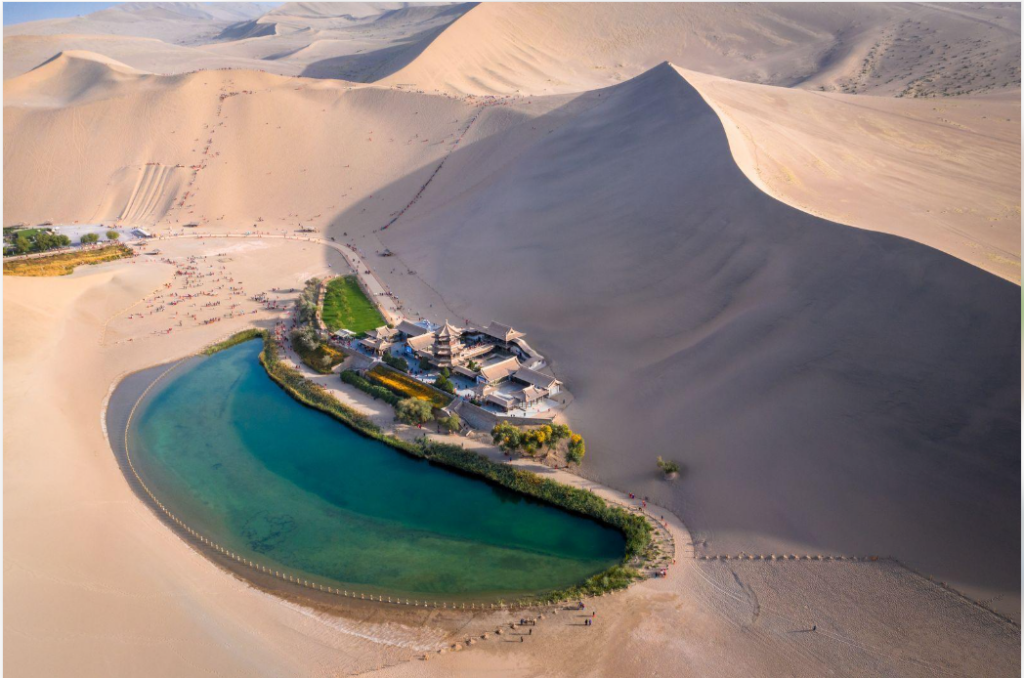
Our journey begins in Dunhuang, an ancient oasis along the legendary Silk Road, where the Gobi Desert meets one of the most evocative sights in all of China: Yueyaquan Lake, known as Crescent Moon Lake: Imagine walking among immense dunes, as soft as golden velvet, while the wind draws delicate waves across the sand. Suddenly, in the heart of this amber-coloured ocean, a mirror of water appears, perfectly shaped like a crescent moon. All around, small buildings of traditional Chinese architecture seem to watch over a miracle of nature. It is difficult to believe that such a delicate place could exist in the middle of the desert. Yet the lake is there, silent and enchanting, surviving thanks to a natural balance now also supported by conservation efforts. As the sun begins to set, the dunes take on rosy shades, the sky turns peach-coloured and everything seems to transform into a romantic scene from an ancient Eastern tale.
Not far from this wonder lie the Mogao Caves, one of Asia’s most extraordinary artistic treasures. Carved into the rock beginning in the 4th century, they preserve centuries of murals, Buddhist sculptures and decorations that bear witness to the encounter between Chinese culture and artistic influences from Central Asia and India. For those who love the history of costume, these caves represent an emotional journey through the elegance of distant eras. The painted figures wear wide-sleeved robes, richly decorated fabrics, elaborate headdresses and exquisite jewellery. The silks seem to move across the walls, while images of the apsaras, the celestial beings of Buddhist art, float among clouds and flowers like dancers suspended in eternity. It is impossible not to think of the atmospheres of great historical C-dramas, those sumptuous sets and magnificent costumes that fascinate us so much. But here we are not looking at the reconstruction of a film set: we are standing before authentic testimonies of civilisations that helped shape the aesthetic imagination of the East.
Leaving Dunhuang, the journey continues towards Zhangye, in Gansu, where nature seems to have delighted in painting the mountains with a palette of colours.
The famous Rainbow Mountains, known as Zhangye Danxia, are one of China’s most astonishing geological sights. Immense rocky undulations stretch towards the horizon, revealing layers of red, orange, yellow, brown and violet, shaped over millions of years. Watching them at sunset is an unforgettable experience. The light caresses the ridges, intensifies their shades and transforms the mountains into an immense natural painting. There are no brushes or artificial pigments: only time, the earth and nature’s extraordinary ability to create beauty.
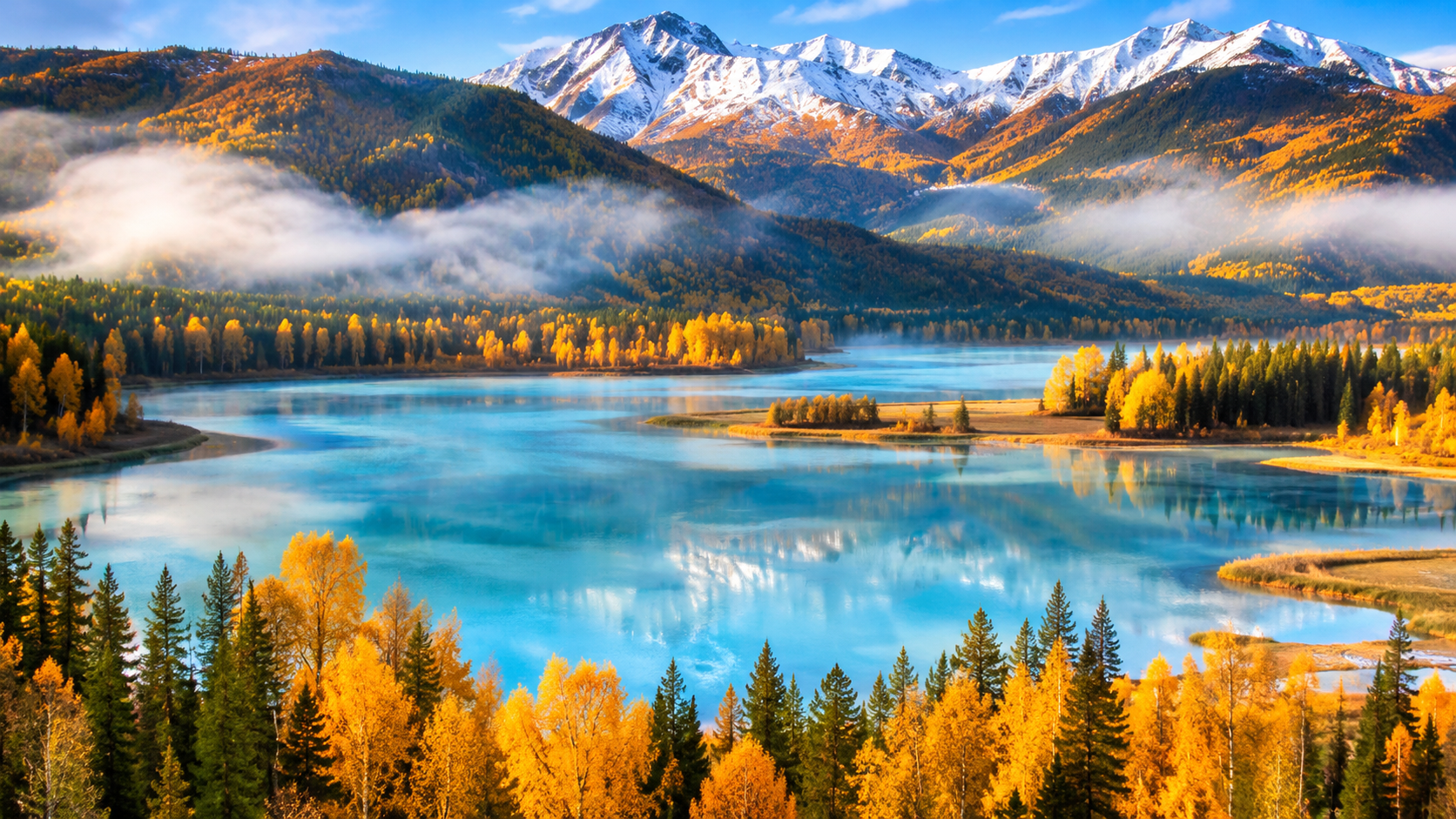
Continuing westward, the landscape changes once again and leads us into Xinjiang, a land of spectacular contrasts, where boundless deserts coexist with snow-capped peaks, alpine forests and lush green grasslands. Here lies Kanas Lake, one of the most enchanting places in the entire region. Its waters, which can take on turquoise, green and blue hues, wind between forest-covered mountains, creating a scene reminiscent of the illustrations in a fairy-tale book. In autumn, the landscape becomes even more extraordinary. The trees turn gold, copper and red, while a thin mist slowly rises from the surface of the lake. The mountains seem to emerge from the clouds and silence envelops everything. It is one of those places where one would wish to remain for hours, simply watching the light change, listening to the wind among the trees and surrendering to the feeling of having reached the ends of the earth.
Not far away lies Hemu, a traditional village nestled among mountains and forests, also inhabited by Tuvan and Kazakh communities, who preserve important elements of their cultural traditions. The wooden houses, with their sloping roofs and small chimneys, seem to belong to another era. In the morning, when smoke slowly rises from the homes and mist envelops the valley, the village takes on an atmosphere so evocative that it seems unreal. In autumn, golden forests frame the houses; in winter, snow covers the rooftops and transforms Hemu into a small enchanted kingdom. Here, beauty does not come from luxury or the grandeur of monuments, but from the simplicity of a life deeply connected to nature.
The journey continues towards Sayram Lake, a stretch of crystal-clear water nestled among the mountains of Xinjiang. In spring and summer, the surrounding grasslands fill with wildflowers and the intense green of the grass meets the luminous blue of the lake. Snow-capped mountains are reflected in the water, while clouds drift slowly across a sky that seems to have no boundaries. It is a landscape of breathtaking beauty, capable of conveying a feeling of absolute freedom. It is not difficult to imagine ancient travellers crossing these lands, accompanied by the sound of horses’ hooves and the wind sweeping across the great plains. The history of the Silk Road belongs not only to cities and markets: it also lives in these immense landscapes, crossed over the centuries by peoples, caravans and different cultures.
Another wonder awaits us among the Tianshan Mountains: Heavenly Lake of Tianchi, near Ürümqi.
Surrounded by coniferous forests and dominated by imposing peaks, this alpine lake possesses a solemn and mysterious charm. Its waters reflect the mountains and the sky, creating a landscape that seems born from a painter’s imagination. In Chinese mythology, the Tianshan area is also associated with the legends of the Queen Mother of the West, Xiwangmu, a fascinating figure linked to immortality and the divine world. It is precisely this fusion of nature and legend that makes the place even more evocative.
And then there is Qinghai, a land of boundless plateaus, mountains, monasteries and vast expanses of water.
Qinghai Lake, the largest lake in China, stretches like a blue sea among grasslands and mountain ranges. During summer, in certain areas along its shores, rapeseed fields bloom, creating immense yellow expanses that contrast magnificently with the deep blue of the water. The wind sweeps across the meadows, clouds cast gentle shadows over the mountains and prayer flags, found in various places throughout the region, recall the profound influence of Tibetan culture. Here, the journey takes on an almost spiritual dimension. No words are needed to understand the grandeur of the landscape: one only has to stop, gaze at the horizon and allow oneself to be filled with that sense of wonder that only certain places can inspire.
But what makes northwestern China truly unforgettable is not only the extraordinary variety of its landscapes. It is its multicultural soul, the result of centuries of encounters between East and West.
Along the ancient trade routes travelled silks, spices, precious stones, ceramics and fabrics, but also ideas, religions, artistic techniques and knowledge. The oasis cities were places of exchange, where merchants and travellers from distant worlds met, helping to create a cultural heritage of incredible richness. Even today, travelling through these territories, one can encounter Han Chinese, Uyghur, Kazakh, Hui, Tibetan and other communities’ traditions, each with its own history, artistic expressions, cuisine and costumes. The markets are filled with the scents of spices and freshly baked bread, fabrics display embroidery and patterns handed down through time, while traditional music tells of cultural identities that deserve to be known and respected. It is a China that continually surprises, because it does not correspond to a single image, but to a mosaic of landscapes and civilisations.
This is precisely the secret of its charm: its ability to make us feel small before the greatness of nature and, at the same time, incredibly close to the stories of the men and women who have inhabited these lands. There are journeys undertaken to discover new places, others to admire monuments or explore different cultures, and then there are destinations that seem to speak directly to our imagination, awakening that childhood desire to explore the world, to go beyond the horizon and discover what lies beyond the mountains, until it almost becomes a dream to be experienced slowly, without haste, allowing ourselves time to admire a sunset over the dunes of Dunhuang, to lose ourselves in the colours of the mountains of Zhangye, to watch the mist rising over Kanas Lake or to listen to the silence of a small village among the forests of Xinjiang.
And when the journey draws to an end, the magic of those places continues to live within us, like a dream from which we never wish to awaken. What remains before our eyes is the immensity of a sky that seems to touch infinity, mountains painted in the colours of eternity, enchanted lakes hidden among silent forests and ancient frescoes that, across the centuries, continue to whisper stories of love, legends and lost civilisations, while in our hearts there remains the sweetest nostalgia, that of a mysterious and timeless land that seems to hold a thousand more secrets waiting to be revealed. A China that never ceases to amaze, where every horizon promises a new wonder and every sunset leaves an irresistible desire to return, to pursue once again the beauty of a dream that seems never to end.
Perhaps the true magic of travel is precisely this: discovering that there are still places capable of making us dream with our eyes wide open.
And in northwestern China, among the sands of the Silk Road and the mountains that touch the sky, those dreams seem to have no end.