
Love That Defies Time to Rewrite Destiny
Love That Defies Time to Rewrite Destiny
A journey between past and present, where memories become a second chance and love finds the courage to change what seemed already written.
How many times, throughout our lives, have we wished we possessed a time machine. How many times have we wanted to go back, not only to recover lost moments, missed opportunities or words left unspoken, but above all to correct our mistakes and change the destiny of the people we love. And if we were truly granted a second chance, how far would we be willing to go to avoid losing someone? It is precisely from this deeply human desire that Dive Into You comes to life, a romantic fantasy K-drama capable of intertwining love, memory and destiny. But alongside its protagonists, guarding the mystery of the story, we also find a film screenplay with an emblematic title: Lost Time, time that has been lost. Pages that seem to know what no one should know, as though someone had already lived, witnessed and written every fragment of those lives. Yet what sets everything in motion is always the same force: Love, genuine love, which represents the very essence of life, which knows no boundaries, refuses separation and rebels even against destiny. Because without love, we may perhaps continue to exist, but it is difficult to feel truly alive. Dive Into You tells precisely this: the strength of a feeling willing to defy time, to fight against everything and everyone, rather than lose what makes our existence precious. And it leaves us suspended before a question: if we could rewrite the past to save those we love, would we truly have the courage to do so?
Dive Into You: a love story between past, present and destiny
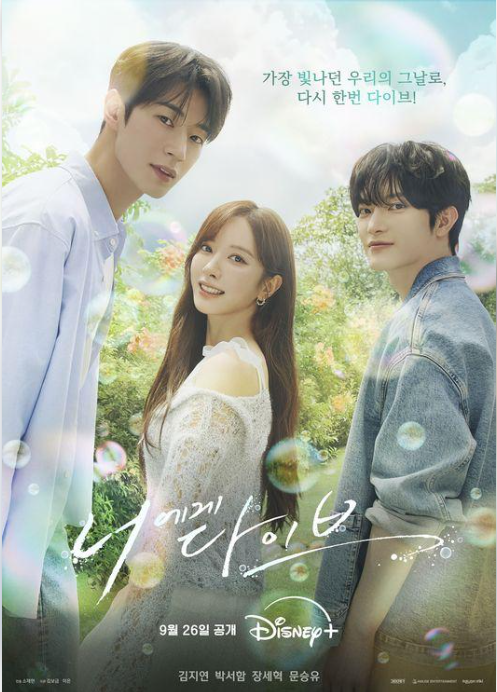
Released on September 26, 2026, Dive Into You (original Korean title 너에게 다이브) is a 12-episode South Korean series that combines romance, comedy, fantasy and mystery.
At the heart of the story is Yoon Ha-na, a famous actress who appears to have achieved everything. Behind her success and fame, Ha-na carries a pain that no professional recognition has ever managed to erase: the loss of Jung Woo-jae, her first love, childhood friend and the man who protected her to the point of sacrificing his own life. A former judo prodigy, Woo-jae gave up part of his dreams, remaining deeply devoted to the woman he loves. But when an old video camera reappears in Ha-na’s life, something extraordinary happens. Together with her twin brother Yoon Ha-ru, she discovers that she can travel through time and return to their younger years, when dreams were still intact and the future seemed to offer endless possibilities.
The journey, however, conceals an unpredictable complication: the twins find themselves swapping bodies, giving rise to amusing situations, misunderstandings and moments of great tenderness. What initially appears to be an incredible supernatural phenomenon soon turns into a desperate mission: to prevent Woo-jae’s death and give love another chance. But changing the past does not necessarily mean being able to control the future. Every choice can alter other lives, every attempt to save someone can generate unexpected consequences. And destiny, sometimes, seems to find new ways to reclaim what has been taken from it.
Lost Time: the screenplay that holds a mystery
One of the most fascinating aspects of the series is precisely the presence of Lost Time, a film screenplay that becomes a fundamental element of the story. It is not simply a film to be made, but a story within a story, capable of raising unsettling questions: how can a screenplay contain such precise details of the protagonists’ lives? Who actually wrote those pages? And above all, what connection exists between their love story and the secrets of time travel? A decisive role in this mystery belongs to Yang Jun-mo, a film director, a figure connected to Ha-na’s professional past and to the making of Lost Time. It is here that the drama goes beyond the boundaries of a simple romantic story, transforming itself into a tale about the relationship between reality and fiction, between what we have experienced and what we would like to rewrite, because a screenplay, just like life, is made up of encounters, separations, choices and endings. But while on paper we can erase a scene and write another, in reality every decision leaves a trace.
The protagonists and the feelings that unite them
Kim Ji-yeon (Bona) plays Yoon Ha-na, a woman who hides fragility, regrets and the desire to become once again the girl she was before losing her love, behind her image as a successful actress. Her performance alternates between brilliant and deeply emotional moments.
Park Seo-ham, in the role of Jung Woo-jae, brings to life a reserved, loyal and protective male protagonist. His is a love that reveals itself above all through gestures, glances and the ability to put another person’s happiness before his own.
Jang Se-hyuk plays Yoon Ha-ru, Ha-na’s twin brother and an outstanding judo athlete. His character brings lightness and comedy, but also represents the strength of family bonds and the courage to make sacrifices to protect those we love.
Moon Seung-you takes on the role of Son Ye-rang, a determined woman, an executive at Ha-na’s agency and Ha-ru’s partner. Through her character, the drama explores another dimension of love: that of a relationship built over the years, made of trust, misunderstandings and shared choices.
The cast also includes Ha Do-kwon and Park Mi-hyun, in the roles of the twins’ parents, and Kim Han-young, who plays Lee Hyung-won, Woo-jae’s sporting and romantic rival.
Direction, screenplay and cinematography
The direction is entrusted to So Jae-hyun, already known for works such as 100 Days My Prince, Shooting Stars and My Lovely Liar, while the screenplay bears the names of Kim Bo-geum and Lee On. The distinctive feature of the narrative is its ability to alternate between different tones without losing the emotional thread of the story: from romantic comedy to drama, from youthful nostalgia to suspense.
The cinematography contributes significantly to the atmosphere. Warm lighting, backlighting, luminous landscapes and images with a nostalgic quality accompany the protagonists’ memories, while the contrast between past and present becomes an integral part of the visual language.
The old video camera is not merely a fantastical device, but represents the desire to preserve what time inevitably takes away. Through its lens, memories acquire an almost tangible consistency, like photographs that suddenly come back to life.
The costumes and settings also help distinguish the different moments of the narrative, accompanying the characters’ transformation, from the carefree spirit of their younger years to the greater awareness of adulthood.
The music: when feelings become melody
The original soundtrack, supervised by music director Heo Sung-jin, accompanies the most intense moments of the series and brings together several voices from the Korean music scene. Among the performers are Rei of IVE, with the song Hello, and Mingi of ATEEZ, with Where Are You, alongside artists such as Kangnam, Jeon Geon-ho, Lee Min-hyuk and Jung Ye-won.
The music intertwines with the characters’ feelings, giving voice to the melancholy of memories, the joy of encounters and that particular nostalgia that arises when we understand how precious the moments we have lived truly are.
A love that refuses to surrender to time
Produced by Dexter Pictures, Amuse Entertainment and Rakuten Viki, Dive Into You is an international co-production between South Korea, Japan and the United States. The series was broadcast on Channel A, made available on Disney+ in some Asian markets and distributed internationally through Rakuten Viki. But beyond the production, narrative effects and time travel, what truly remains impressed upon us is the message this story wishes to convey. We all carry a lost time within us. A moment we would like to relive, a person we wished we could have held on to, a choice we would make differently today. Because time may slip away from us, memories may fade and destiny may surprise us, but genuine love leaves traces that no distance and no calendar can erase.
And this is what makes Dive Into You a story capable of moving us: it does not simply tell of the desire to go back, but of an even greater longing, that of never having to say goodbye to the person we love.


