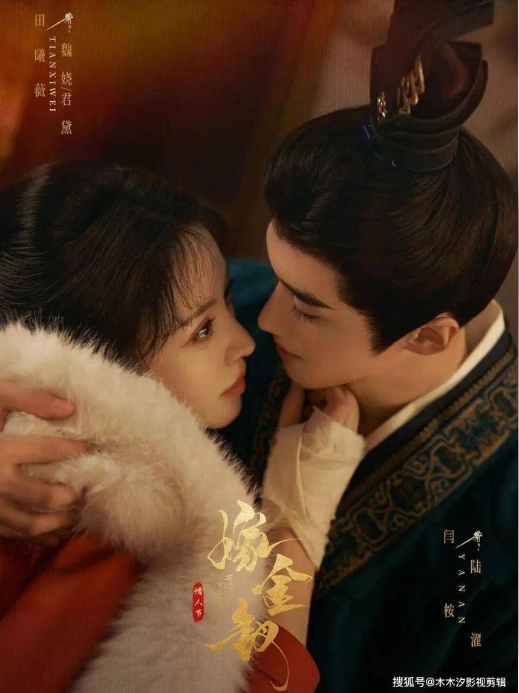
From the title alone, it seems to promise a story suspended between love and beauty. Having reached the end of this C-drama, captivated by its atmosphere and by the delicacy with which its emotions come to life, I understood that the beauty evoked by the title goes far beyond what the eyes can see.
The magnificence of this story lies in the love that slowly blossoms, almost on tiptoe, between two people initially united solely by a marriage of convenience and destined, instead, to truly choose one another. Even before love comes respect and trust. Then their gazes change, the distance between them grows smaller, and that silent complicity begins to emerge, made of listening, patience, protection, desire, and sharing. While rivalries, interests, dangers, and wounds unfold around them, the protagonists slowly build a world that belongs only to them, made of gestures, words, silences, and glances capable of saying far more than any declaration.
The actors make this transformation feel so natural that we perceive their feelings even before they are spoken, and they remind us that loving someone does not mean possessing them or losing oneself in the other, but walking together while remaining true to oneself; meeting each other halfway, respecting one another, protecting without suffocating, and continuing to choose each other even when the world around them seems determined to tear them apart. Perhaps, then, the true meaning of the beauty contained within this drama is precisely this: finding someone before whom there is no need to defend yourself, someone with whom you can feel welcomed, desired, respected, and understood, because, in the end, the most beautiful form of love is not simply meeting one another, but recognizing each other, choosing each other, and becoming, day after day, a home for one another.
The Prisoner of Beauty (折腰, Zhe Yao) is a 2025 Chinese historical-romance C-drama, adapted from the web novel of the same name by Penglai Ke. Consisting of 36 episodes, it was produced by Tencent Video and Fat Bear Production and premiered on May 13, 2025. The screenplay was written by Nan Zhen, while the principal director is Deng Ke.
Plot
At the heart of the story is Xiao Qiao, played by Song Zu’er, a young woman belonging to the Qiao family, beautiful but above all intelligent, intuitive, and endowed with a strong sense of responsibility. On the other side is Wei Shao, played by Liu Yuning, the powerful lord of the Wei family, an apparently cold and uncompromising warrior deeply scarred by his past.
The Qiao and Wei families are divided by an old grudge: fourteen years earlier, a retreat ordered by Xiao Qiao’s grandfather during a battle caused the deaths of members of the Wei family. When, years later, Wei Shao advances toward Yanzhou, Xiao Qiao understands the gravity of the situation and agrees to a political marriage with him in order to avert a conflict.
It is precisely from this marriage, born without love and burdened by the weight of hostility between the two families, that the heart of the drama comes to life.
At first, Xiao Qiao and Wei Shao regard each other with suspicion, almost as though they are studying one another. But the trials they face together gradually transform that distance into respect, respect into trust, and finally trust into an increasingly profound feeling. Theirs is not merely a love story: it becomes a true alliance between two people capable of recognizing each other’s strength.
Song Zu’er and Liu Yuning: Xiao Qiao and Wei Shao
It is above all the construction of the two protagonists that gives the series its charm.
Xiao Qiao is not portrayed simply as the beautiful woman evoked by the title. Her true strength lies in her intelligence: she knows how to observe, understand political dynamics, mediate, and find solutions without giving up her sensitivity. Her outward beauty becomes almost secondary compared with her ability to slowly enter Wei Shao’s world.
Wei Shao, on the other hand, represents her counterpoint: he is a man shaped by pain and responsibility, accustomed to war and command. His initial harshness toward the Qiao family makes the transformation of his relationship with Xiao Qiao all the more meaningful. It is not simply a matter of her “melting” the cold man: they both change through their relationship and their confrontation with one another.
The chemistry between Song Zu’er and Liu Yuning becomes fundamental. Much of the emotion is conveyed through small gestures, hesitations, silences, and glances, making the transition from distrust to intimacy feel not sudden, but earned.
Alongside them, we also find Xuan Lu in the role of Su Ehuang, Liu Duanduan as Wei Yan, veteran actress Liu Xiaoqing as Madame Xu, He Hongshan as Da Qiao, and Li Xueqin as Xiao Tao.
Deng Ke’s Direction
One of the most successful elements is the direction of Deng Ke, who accompanies the political and historical component with a strongly romantic staging. The drama alternates family conflicts, power struggles, and military tensions with much more intimate moments, in which light, the physical distance between the characters, and above all their gazes tell us what is happening emotionally. The cinematography often favors soft tones and elegant compositions, while sets, lighting, and costumes contribute to the emotional construction of the sequences. They are therefore not simply a spectacular backdrop: aesthetics become part of the narrative.
The Costumes: Beauty Tells the Story of the Characters
It is precisely from the point of view of costume design that The Prisoner of Beauty deserves particular attention. The costume design is credited to Ivan Ai, and the work on the protagonists’ visual identities never seems purely decorative.
For Xiao Qiao, soft lines, light layering, and delicate shades predominate, emphasizing her grace without diminishing her strength. For Wei Shao, by contrast, the clothing initially tends toward darker colors, more defined structures, and a more austere and martial presence. This chromatic and formal contrast has also been noted in analyses of the production: Wei Shao’s dark and authoritative tones stand in contrast to Xiao Qiao’s lighter, airier shades, visually accompanying their personalities and their evolution. Particularly interesting is the choice to use the quju (曲裾), a type of Hanfu garment less frequently seen in recent historical dramas. According to the production, the structure of the quju slightly restricts the length of the wearer’s stride, thereby giving Xiao Qiao a more composed and elegant bearing. The combination of more substantial fabrics with veils and lightweight materials also stems from a precise aesthetic vision.
And perhaps this is precisely one of the series’ visual secrets: the costumes do not merely dress the characters; they tell us what the characters themselves are not yet able to say.
At the beginning, Xiao Qiao and Wei Shao seem to belong to two different worlds, even in their visual appearance; as the story progresses, however, the distance between those worlds seems to gradually diminish. Exactly as happens with their feelings. This is why The Prisoner of Beauty goes beyond the appeal of the classic historical romance. Behind the sumptuousness of its imagery, it tells us something surprisingly simple and contemporary: two people may be brought together by circumstances, but only respect, trust, and the daily choice to meet each other halfway can transform that union into love.
And it is there that the title perhaps acquires its most beautiful meaning: the beauty capable of making us truly “prisoners” is not the beauty of a face, but the far rarer beauty of finally feeling understood and loved by someone who, despite everything, continues to choose us.
“Official Trailer: © Tencent Video / WeTV”